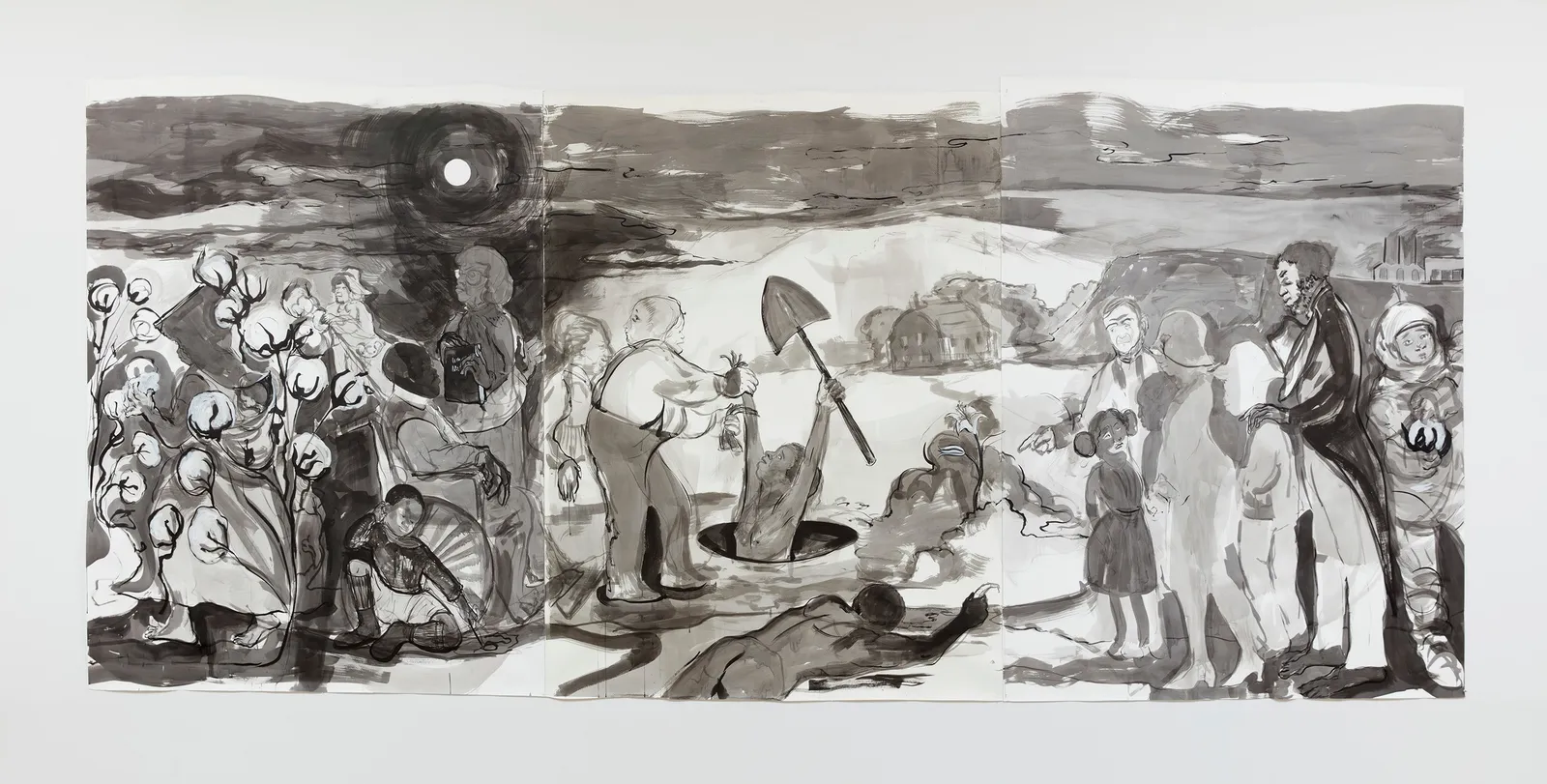
Kara Walker Stockton, California, born 1969
A Burial at the Artist’s Country Estate, 2022
Sumi-e ink and gofun on paper
100 1/2 x 224 inches (255.3 x 569 cm) framed
Kara Walker’s 'A Burial at the Artist’s Country Estate' is a monumental ink work on paper depicting an unnerving scene of provincial last rites. Both the title and structure of...
Kara Walker’s "A Burial at the Artist’s Country Estate" is a monumental ink work on paper depicting an unnerving scene of provincial last rites. Both the title and structure of the work evoke clear parallels to Gustave Courbet’s seminal 1849-50 painting "A Burial at Ornans," with two groups of onlookers positioned on both sides of a center grave. Yet the most striking difference between Courbet’s "Burial" and Walker’s—besides the implication of proprietorship in the title—is the presence of not one, but two figures at the grave. Unlike the empty, open plot of earth at the bottom of Courbet’s painting, the focal point of "A Burial at the Artist’s Country Estate" shows a naked woman midway into a gaping hole in the ground, with another body lying prone nearby. One cannot immediately tell if the central woman is being lowered into the dark opening or pulled from it; her arms are outstretched above her head, holding a shovel in one hand while the other is gripped at the wrist by a ghostly two-faced figure standing by the grave. Only the despair on her face is clearly legible, suspended between submersion and ascension.
Though not overtly auto-biographical, Walker’s anachronistic crowd contains several references to members of her own cotton-farming family from Georgia. The subjects depicted include her father, as a child, drawing in the dirt; her Baptist minister uncle, seated in a wheelchair and raising a finger; a Bible-clasping aunt; and a hooded woman carrying an infant on her back, roaming through a field of cotton. The tension between flight and imprisonment pervades the drawing's composition, with the dug-out grave functioning as both an escape hatch and site of entombment for the fallen body. The presence of the astronaut, evoking Afro-Futuristic imagery, similarly suggests a possibility of liberation—an unboundedness to gravity and past and present subjugation. The onlookers’ reactions towards the central scene are varied, with some turned away and others gazing on solemnly. Altogether, their function as guests on the “artist’s country estate”—bearing suspicious resemblance to the artist's own house in the country—remains ambivalent; rather, their presence as witness to the violence of burial against any conceivable freedom recasts this art historical tableau within Walker’s own visual mythology, and the force of its history as contemporaneous and consuming.
Though not overtly auto-biographical, Walker’s anachronistic crowd contains several references to members of her own cotton-farming family from Georgia. The subjects depicted include her father, as a child, drawing in the dirt; her Baptist minister uncle, seated in a wheelchair and raising a finger; a Bible-clasping aunt; and a hooded woman carrying an infant on her back, roaming through a field of cotton. The tension between flight and imprisonment pervades the drawing's composition, with the dug-out grave functioning as both an escape hatch and site of entombment for the fallen body. The presence of the astronaut, evoking Afro-Futuristic imagery, similarly suggests a possibility of liberation—an unboundedness to gravity and past and present subjugation. The onlookers’ reactions towards the central scene are varied, with some turned away and others gazing on solemnly. Altogether, their function as guests on the “artist’s country estate”—bearing suspicious resemblance to the artist's own house in the country—remains ambivalent; rather, their presence as witness to the violence of burial against any conceivable freedom recasts this art historical tableau within Walker’s own visual mythology, and the force of its history as contemporaneous and consuming.

Mailing list sign-up
* denotes required fields
In order to respond to your enquiry, we will process the personal data you have supplied to communicate with you in accordance with our Privacy Policy. You can unsubscribe or change your preferences at any time by clicking the link in our emails.