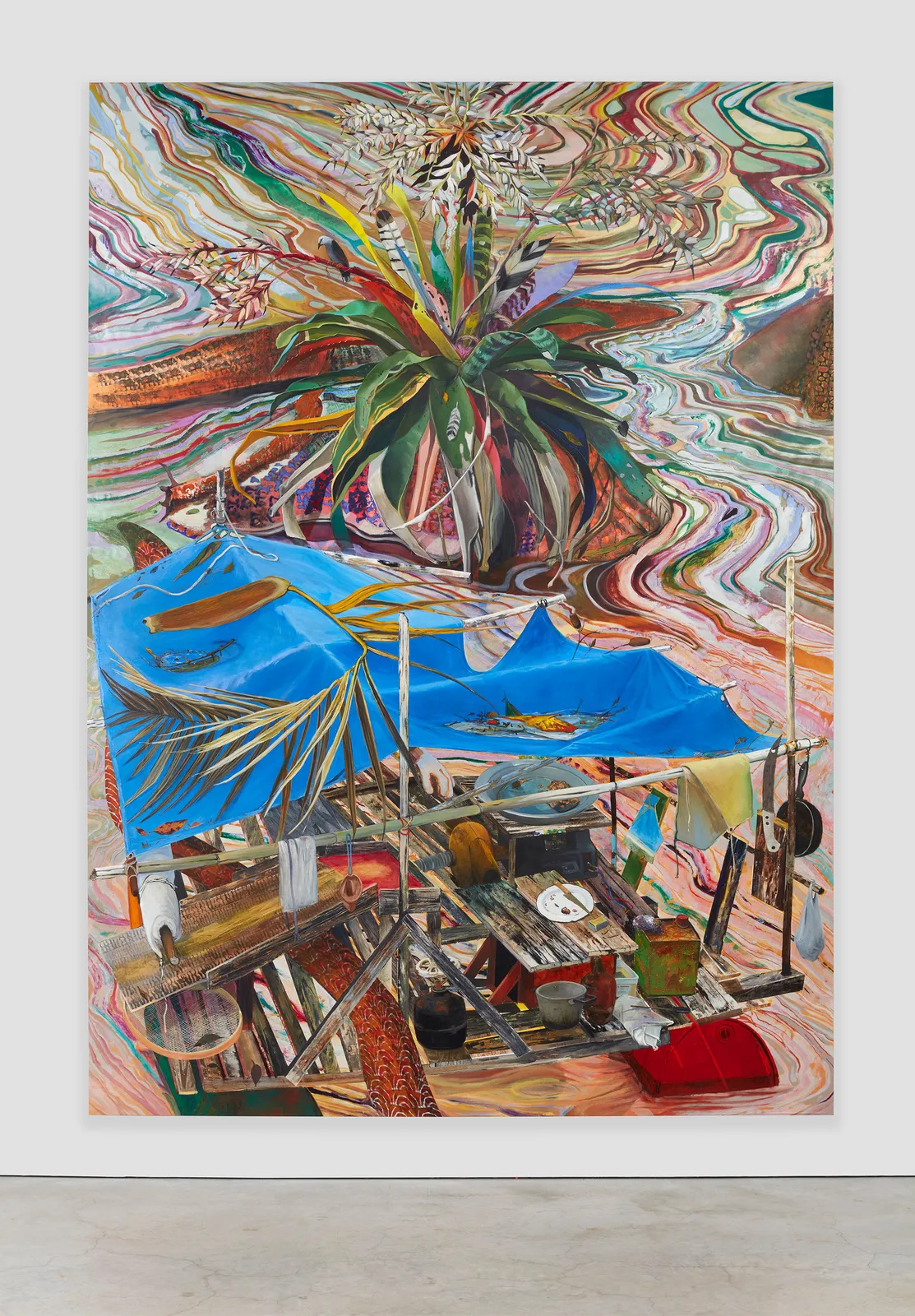
Luiz Zerbini São Paulo, Brazil, born 1959
Rio das mortes, 2021
Acrylic on canvas
150 x 110 1/4 inches
381 x 280 cm
381 x 280 cm
During his candidacy, Brazil’s president, Jair Bolsonaro, had announced his support for mining, including mining in Indigenous areas. Throughout his presidency, he has cut even more than his predecessor the...
During his candidacy, Brazil’s president, Jair Bolsonaro, had announced his support for mining, including mining in Indigenous areas. Throughout his presidency, he has cut even more than his predecessor the budgets of the agencies founded to control and repress illegal mining and of the agency in charge of protecting the Indigenous people. Mining remains illegal but inspection is lacking.
The Yanomami region, in Roraima, has been witnessing the fourth major invasion of prospectors since the late 1970s. They currently reach between 20 and 26 thousand miners in the river canals of the Uraricoera, Mucajaí, Couto de Magalhães Rivers, and in the basins of the Catrimani, Novo, and Apiaú Rivers. Mining produces dead rivers. It rips out soil like wild boars, as the Yanomami people say. [...] It opens up clearings of devastation in the forest, destroys the riverbanks, and fills smaller rivers with mud—these tributaries carry 7 million tons of mud a year into the Tapajós River channel. It also opens up deep craters that, once abandoned, expose soil that cannot be regenerated, and stagnant pools of water in which malaria mosquitoes thrive.
The poor, of which there are many in Brazil where poverty keeps getting worse, make up the frontline miners. They work under varied informal contracts drawn up by the “mine owners.” The owners of planes and helicopters that supply this activity profit greatly, as do the commerce of the nearest cities and the owners of the machinery. However, with each outbreak of gold exploration, the wave of wealth that passes through the region is short-lived, lasting from three to five years, not enough to improve health, education, and per capita Gross Domestic Product indicators. Nothing gets better.
In February 2020, the Executive branch proposed Bill no. 191/2000, which is unconstitutional in multiple ways and signals a massive offensive to allow mining on Indigenous land. [...] The Agência Nacional de Mineração [National Mining Agency] (ANM), responsible for licenses and research, should not receive or process any requests for mining on Indigenous lands, since such mining, not only for gold but also for any mineral, is illegal. However, a survey carried out in 2020, by the Federação Basileira de Geólogos [Brazilian Federation of Geologists], showed the existence of registrations of requests with the ANM for exploration or for mineral mining on Indigenous lands.
The mining Bill no. 191/2020 disrespects, among other provisions, the right of the Indigenous peoples to a prior and informed consultation to reach the terms of an eventual consent, provided for in at least three international treaties adopted by Brazil. But the Yanomami see this consultation as insufficient. Like many other Indigenous people immune to the biblical tradition, they do not consider themselves the masters of all creation whose only purpose is to serve them. They share the rights to their land with all the other beings that inhabit it. Therefore, in his rejection of mining, Davi Kopenawa adds:
"It is not just we the Indigenous people who live on our land. Do you want to ask all forest dwellers what they think of mining? Ask the animals, plants, the thunder, the wind, the Xapiri spirits, because they all live in the forest. The forest can also take revenge on us when it is hurt." [1]
[1] Hatukara Associação Yanomami, “Carta aberta sobre o desenvolvimento dos Yanomami.” Feb. 2, 2008. Available at https://hutukara.org/images/stories/Carta_aberta_sobre_o_desenvolvimento_dos_Yanomami.doc. Retrieved Nov. 19, 2021.
From Carneiro da Cunha, Manuela. "Rio das mortes." Luiz Zerbini: The Same Story is Never the Same. São Paulo: MASP, 2022. 94-103. Print.
The Yanomami region, in Roraima, has been witnessing the fourth major invasion of prospectors since the late 1970s. They currently reach between 20 and 26 thousand miners in the river canals of the Uraricoera, Mucajaí, Couto de Magalhães Rivers, and in the basins of the Catrimani, Novo, and Apiaú Rivers. Mining produces dead rivers. It rips out soil like wild boars, as the Yanomami people say. [...] It opens up clearings of devastation in the forest, destroys the riverbanks, and fills smaller rivers with mud—these tributaries carry 7 million tons of mud a year into the Tapajós River channel. It also opens up deep craters that, once abandoned, expose soil that cannot be regenerated, and stagnant pools of water in which malaria mosquitoes thrive.
The poor, of which there are many in Brazil where poverty keeps getting worse, make up the frontline miners. They work under varied informal contracts drawn up by the “mine owners.” The owners of planes and helicopters that supply this activity profit greatly, as do the commerce of the nearest cities and the owners of the machinery. However, with each outbreak of gold exploration, the wave of wealth that passes through the region is short-lived, lasting from three to five years, not enough to improve health, education, and per capita Gross Domestic Product indicators. Nothing gets better.
In February 2020, the Executive branch proposed Bill no. 191/2000, which is unconstitutional in multiple ways and signals a massive offensive to allow mining on Indigenous land. [...] The Agência Nacional de Mineração [National Mining Agency] (ANM), responsible for licenses and research, should not receive or process any requests for mining on Indigenous lands, since such mining, not only for gold but also for any mineral, is illegal. However, a survey carried out in 2020, by the Federação Basileira de Geólogos [Brazilian Federation of Geologists], showed the existence of registrations of requests with the ANM for exploration or for mineral mining on Indigenous lands.
The mining Bill no. 191/2020 disrespects, among other provisions, the right of the Indigenous peoples to a prior and informed consultation to reach the terms of an eventual consent, provided for in at least three international treaties adopted by Brazil. But the Yanomami see this consultation as insufficient. Like many other Indigenous people immune to the biblical tradition, they do not consider themselves the masters of all creation whose only purpose is to serve them. They share the rights to their land with all the other beings that inhabit it. Therefore, in his rejection of mining, Davi Kopenawa adds:
"It is not just we the Indigenous people who live on our land. Do you want to ask all forest dwellers what they think of mining? Ask the animals, plants, the thunder, the wind, the Xapiri spirits, because they all live in the forest. The forest can also take revenge on us when it is hurt." [1]
[1] Hatukara Associação Yanomami, “Carta aberta sobre o desenvolvimento dos Yanomami.” Feb. 2, 2008. Available at https://hutukara.org/images/stories/Carta_aberta_sobre_o_desenvolvimento_dos_Yanomami.doc. Retrieved Nov. 19, 2021.
From Carneiro da Cunha, Manuela. "Rio das mortes." Luiz Zerbini: The Same Story is Never the Same. São Paulo: MASP, 2022. 94-103. Print.

Mailing list sign-up
* denotes required fields
In order to respond to your enquiry, we will process the personal data you have supplied to communicate with you in accordance with our Privacy Policy. You can unsubscribe or change your preferences at any time by clicking the link in our emails.