-
Kunstwerke / Werke

Yashua Klos Chicago, Illinois, born 1977
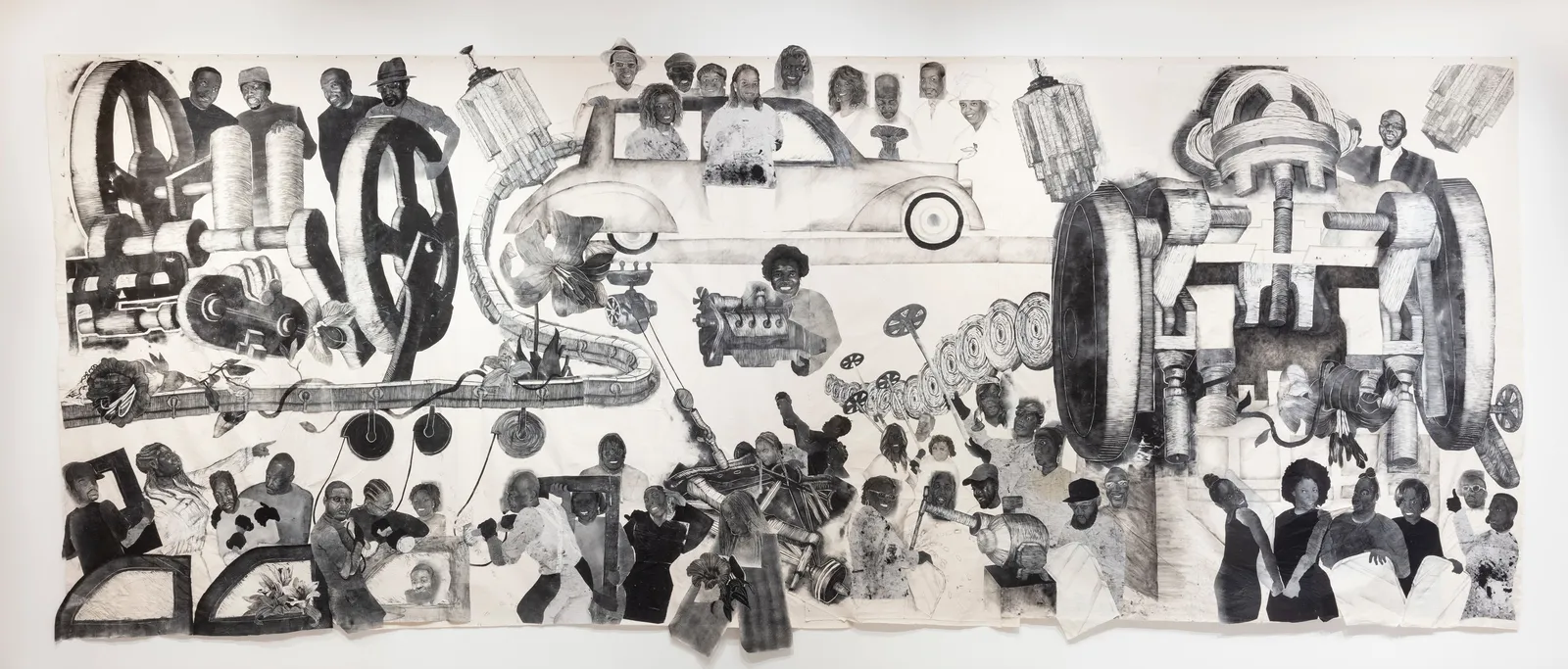
OUR LABOUR, 2020-2021Woodblock print on muslin and oil-based, relief block ink on dropcloth, mounted on canvas188 3/8 x 451 1/4 inches
478.5 x 1146.2 cm'During my second visit to my newfound family, I visited the Detroit Institute of Arts to take in Diego Rivera’s Detroit Industry Murals (1932–33). I had seen this masterwork in..."During my second visit to my newfound family, I visited the Detroit Institute of Arts to take in Diego Rivera’s Detroit Industry Murals (1932–33). I had seen this masterwork in art history books as an undergraduate student, but in person, I was blown away by its scale and detail. I also couldn’t help but feel that Black families like mine, who migrated from the South for jobs at this very same plant, had been left out of this iconic depiction of American history.
Months after I saw the mural, I began to formulate a strategy to subvert its compositional structure with an entirely new agenda. Being part of such a large family, I grew confused trying to keep track of family relationships, so I decided to make a diagram. The figures in OUR LABOUR are arranged according to my patrilineal family tree. My Grandma is in the center “dropping the motor” with her first four McDonald children (including my dad) in the upper left of the mural. Her nine Massey children are in the center above her, and her last child, Paul Greene, is on the far right. All my first cousins, nieces, and nephews populate the plant floor below.
The truth is, Rivera was historically accurate in his depiction of Ford’s workforce at the time: mostly white and all male. As a Communist, Rivera viewed the worker as the proletariat, sacrificing individuality for the whole, through labor. You’ll find Rivera’s figures are often facing down or away from the viewer. The portraits in my mural serve to intervene on this incomplete account of history by putting faces to that invisible labor.
While I aim to pay tribute to the contribution of Black people in this chapter of building the American economy, I also find myself compelled to reject the expectation of labor placed on the Black body. Many figures are face-forward and smiling, as if posing for a large family photo, while there’s not much factory work happening. I thought about all the family photos recently shared with me of the reunions, holiday gatherings, and parties that I’ve missed. At the top of the mural, I added Art Deco chandeliers, swaying from this celebration of togetherness." —Yashua Klos

Mailing list sign-up
* denotes required fields
In order to respond to your enquiry, we will process the personal data you have supplied to communicate with you in accordance with our Privacy Policy. You can unsubscribe or change your preferences at any time by clicking the link in our emails.